Table of Contents
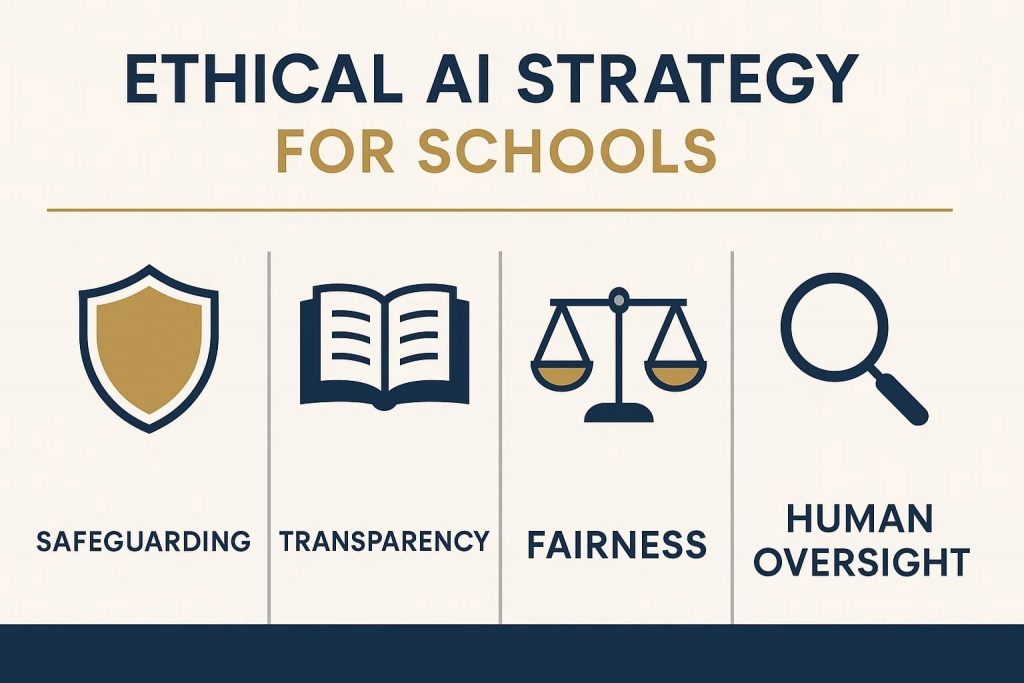
A strategy for ethical AI provides leaders with the framework necessary to transition from doubt to intentional execution. It guarantees that innovation aligns with school principles, promotes learner wellbeing, and enhances teaching instead of making it more complex. In this article, we present a straightforward, step-by-step method for developing a comprehensive AI strategy for schools that emphasizes safeguarding, transparency, and responsible leadership, which is a framework that enables educational institutions to adopt AI confidently while safeguarding their core values.
Understanding the Role of School Leaders in Ethical AI
School leaders are central to how AI is adopted, interpreted, and sustained across a school community. Their decisions shape not only the tools that enter classrooms but also the culture and expectations surrounding their use. When AI is introduced without clear leadership, schools risk fragmented adoption, inconsistent practices, and potential safeguarding concerns.
Leaders provide the direction needed to ensure AI serves a purposeful role in learning. This includes setting expectations for responsible use, supporting teachers in adapting their practice, and communicating openly with families about how AI enhances, rather than replaces, human judgement. With thoughtful leadership, AI becomes a lever for improved teaching, stronger inclusion, and better outcomes for learners.
Why Leadership Accountability Matters
Responsibility is central to any ethical AI approach. When schools start trying out new technologies, it’s essential for someone to oversee expectations, handle risks, and guarantee that every choice complies with safety responsibilities. Lacking defined ownership, the adoption of AI may veer off course, resulting in varied practices and unnecessary errors.
Leadership responsibility is important for various reasons. Initially, ethical risks concerning bias, learner information, and unsuitable AI results necessitate intentional supervision. These matters cannot be wholly assigned to IT teams or separate educators. They require strategic choices from individuals who grasp the wider educational objectives of the institution.
Secondly, communities seek comfort from school leaders. Parents seek to understand how their child’s data will be utilized. Educators seek clear guidelines on what is allowed. Students must experience a sense of security. When leaders demonstrate clear and accountable use of AI, it fosters trust and cultivates an environment where innovation is supported responsibly.
Key Principles of Ethical and Responsible AI Use
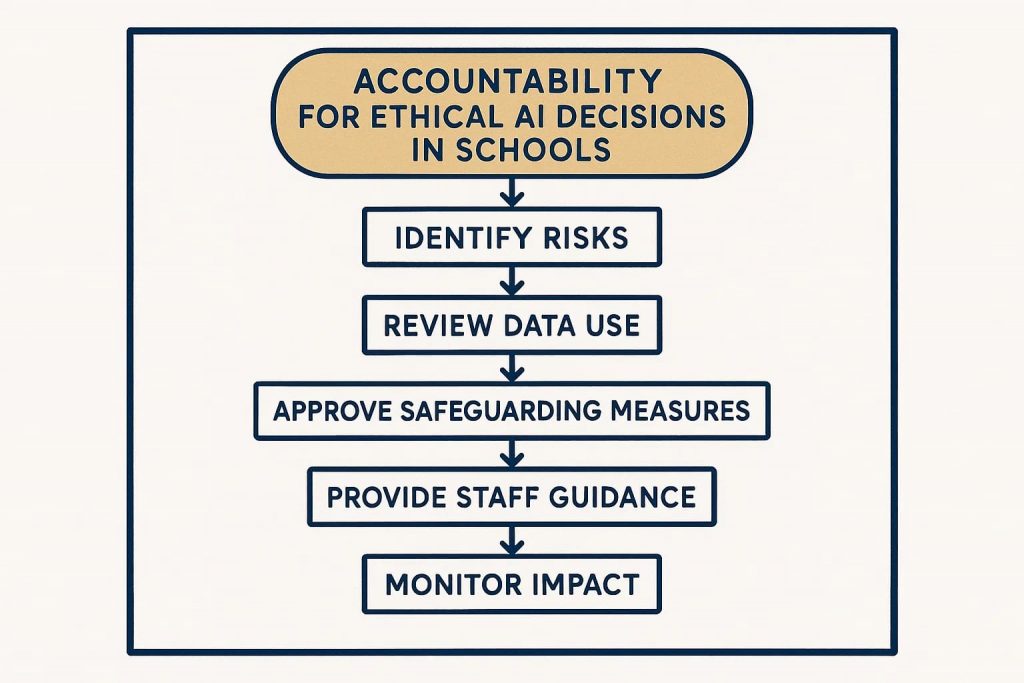
Fairness
AI systems may unintentionally perpetuate bias if they are not evaluated thoroughly. Educational leaders must verify if tools discriminate against specific groups of students or misinterpret information from varied backgrounds. Fairness involves routinely evaluating outputs, questioning assumptions, and opting for tools created with inclusive datasets whenever feasible.
Transparency
Educators, students, and parents require an understanding of how AI tools function and the reasons for their usage. Clear explanations make a significant impact. Describe the system’s functions, the data it utilizes, and how its results will affect educational practices or decision-making processes. Transparency fosters trust and eliminates the perception that AI is a “black box” managing essential functions in the school.
Safety
Each AI tool must go through a protection assessment before it enters the classroom. Leaders need to assess the potential for unsuitable content, erroneous information, or unverified external data sources. Safety also involves making certain that age limitations are observed and that students do not use AI tools without suitable oversight or support.
Human Oversight
AI should guide decisions, not substitute for them. Educators continue to play a crucial role in analyzing results, modifying evaluations, and making sure that the unique needs of students are recognized. Ensuring robust human oversight safeguards against excessive dependence on automated recommendations and upholds the professional knowledge crucial for delivering quality education.
Establishing a Whole-School AI Vision
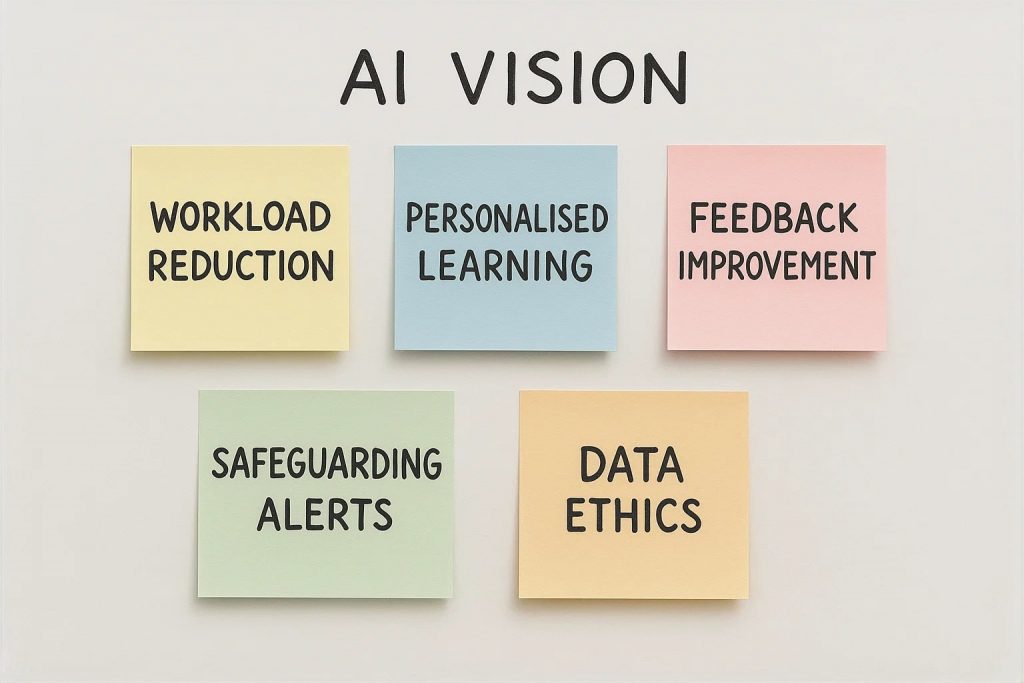
A strong AI strategy begins with a clear vision. Without it, schools run the risk of collecting tools rather than building purposeful practice. An AI vision anchors every decision to the values and priorities of the school, ensuring that innovation enhances learning instead of complicating it.
Start by defining the purpose behind using AI. Is the goal to improve feedback? Reduce teacher workload? Strengthen differentiation? Enhance safeguarding alerts? A shared understanding of “why” prevents reactive adoption and allows staff to see how AI meaningfully supports their work.
Involving teachers early in the process is essential. Their insights reveal what is helpful, what is overwhelming, and where AI has the greatest potential to add value. Invite discussions, gather questions, and create space for scepticism as well as enthusiasm. This collaboration helps establish realistic expectations and builds trust in the strategy.
Aligning AI Strategy with Safeguarding
Every AI decision must begin with safeguarding. Before adopting any tool, leaders should review potential risks such as inappropriate outputs, unsafe data sources, or weak age-filtering. Safeguarding policies must be updated to include AI-specific considerations, ensuring staff understand what is allowed and what requires escalation.
Setting Clear, Measurable Priorities
An effective AI strategy focuses on a small number of high-impact goals. Identify the specific problems AI is intended to solve, such as reducing workload, improving assessment accuracy, or increasing personalisation.
Creating an Ethical AI Framework for Your School
An ethical AI framework provides clear guidance for staff and ensures consistency across the school. It should outline expected practices for procurement, classroom use, data handling, and AI-generated content. Keep the framework practical and easy to apply so teachers can follow it confidently.
Implementation Planning and Capacity Building
Training Staff for Confident AI Use
Provide targeted training that focuses on practical classroom scenarios rather than technical theory. Give staff time to experiment safely, share examples of effective use, and ensure they understand both the benefits and limitations of each tool.
Ensuring Continuous Evaluation and Risk Management
Build simple processes for identifying risks, reviewing tool performance, and documenting any concerns. Maintain a live risk register and update it whenever new tools or practices are introduced.
Monitoring, Reviewing, and Improving Your AI Strategy
How to Conduct Regular Impact Reviews
Review AI tools at set intervals using measurable data, teacher feedback, and learner outcomes. Compare results against your original priorities to determine whether the tools are delivering value.
Involving Learners, Teachers, and Parents in Feedback Cycles
Create structured opportunities for stakeholders to share their experiences, such as short surveys or focus groups. Use this feedback to refine decisions and keep your AI strategy transparent and responsive.
Taking the Next Step
To build confidence in AI leadership and create a strategy that is ethical, safe, and effective, explore the AI Leadership Career Pathway at AISL Academy.